
Nutrient Deficiency in a Toxic World
Why detox-driven nutrient depletion is the hidden barrier to cellular vitality, and how to support the body before, during, and after detox.
The Modern Health Paradox: Eating Well, Still Running on Empty
Many patients are doing the “right” things: clean diets, supplements, lifestyle upgrades. Yet they’re still tired, inflamed, foggy, and slow to bounce back.
That’s not a motivation problem.
And it’s rarely an intake problem.
In today’s world, nutrient deficiency is often driven by chronic toxic exposure and the physiological cost of detoxification.
Every day, the body is dealing with:
Environmental chemicals
Heavy metals
Pesticides and herbicides
Air pollution
Mold metabolites and microplastics
These exposures quietly tax detox pathways and mitochondria, draining nutrients long before deficiencies ever show up on labs.
How Toxins Drain Nutrients (and Why Detox Accelerates Demand)
Detox isn’t passive. It costs energy and it burns through nutrients.
1. Detox Runs on Nutrients
Liver detox pathways — methylation, sulfation, glutathione conjugation — depend on:
Methylated B vitamins
Magnesium
Glycine
Zinc, selenium, and trace minerals
When toxic exposure increases, these nutrients get pulled away from tissue repair, hormone balance, and mitochondrial energy production.
2. Mitochondria Do the Heavy Lifting
Detox demands ATP while increasing oxidative stress at the same time. That raises the need for:
Magnesium
B vitamins
Antioxidant cofactors
Mitochondrial support nutrients
Without support, mitochondrial efficiency drops, fatigue rises and nutrient loss accelerates.
3. Toxins Disrupt Mineral Balance
Heavy metals and chemicals can displace essential minerals at enzyme binding sites. Translation: even when intake looks adequate, utilization isn’t.
What the Research Confirms (2019-2024)
Recent studies mirror what practitioners see daily:
Heavy metal exposure was associated with reduced zinc and selenium, impairing immune and antioxidant function
Roh et al., 2021 – Environment International
DOI: 10.1016/j.envint.2021.106709
Air pollution increases micronutrient turnover and oxidative stress
Wang et al., 2023 – Science of the Total Environment
DOI: 10.1016/j.scitotenv.2023.163095
Environmental toxins raise demand for B vitamins tied to methylation and mitochondrial metabolism
Zhao et al., 2022 – Nutrients
DOI: 10.3390/nu14040748
The takeaways are simple:
Detox without nutrients speeds depletion.
Nutrients without detox rarely restore vitality.
Why Drainage and Cellular Communication Need a Detox Protocol
Drainage doesn’t improve on nutrients alone.
When pathways are congested:
Toxins recirculate
Inflammation climbs
Cellular signaling breaks down
Nutrients struggle to reach tissues effectively
A structured detox protocol like the CellCore Foundational Protocol is designed to:
Open lymphatic and hepatic drainage
Bind and safely escort toxins out of the body
Reduce recirculation
Restore cellular signaling and terrain balance
Support mitochondrial function
Only then can nutrients actually be properly absorbed, retained and used.
Why Nutrients Matter Before, During, and After Detox
Detox isn’t a one-and-done. It’s a process, and each phase has different demands.
Before Detox: Building Resilience
Nutrients help:
Prime detox pathways
Strengthen mitochonrial output
Reduce symptom intensity
During Detox: Preventing Depletion
As toxins mobilize, nutrient demand spikes. Without support, fatigue, headaches, and inflammatory responses follow.
After Detox: Repair and Stabilize
Post-detox is when:
Nutrients shift back to tissue repair
Mitochondrial efficiency rebounds
Long-term nutrient status stabilizes
This is where targeted cellular support through the CellCore Essentials for Cellular Vitality line matters most.
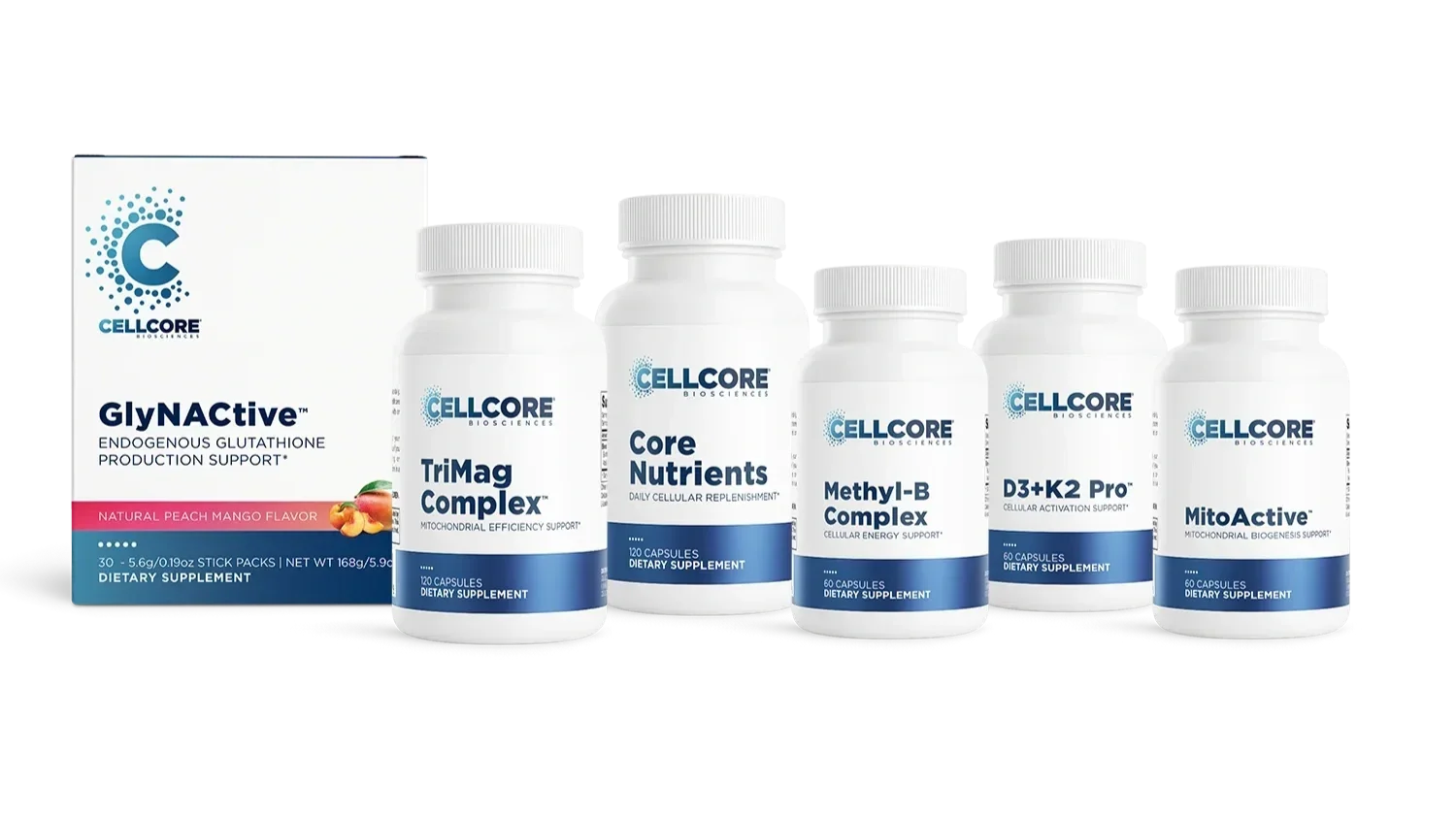
How CellCore Essentials Support Detox-Aligned Recovery
Methyl B-Complex
Supports methylation and Phase II detox signaling while maintaining neurotransmitter balance and energy.
TriMag Complex™
Magnesium supports ATP production, nervous system regulation, and detox enzyme activity — helping stabilize the system during detox.
GlyNACtive™
Glycine + NAC support glutathione production, liver conjugation, antioxidant defense, and tissue repair during detox and recovery.
MitoActive™
Supports mitochondrial resilience under increased detox demand, improving energy output while reducing oxidative stress.
D3+K2 Pro™
Supports immune balance, inflammation control, and mineral signaling — especially during detox-related immune shifts.
Core Nutrients
Replenishes vitamins and minerals lost to detox demand and supports long-term cellular stability.
The Power Pair: Essentials + Foundational Detox
The CellCore Foundational Protocol focuses on drainage and toxin removal.
The CellCore Essentials line provides the nutrient and mitochondrial support needed to detox without depletion.
Together, they:
Reduce nutrient loss
Improve detox tolerance
Restore cellular communication
Support sustainable vitality
Final Takeaway: Nutrients Work Best in a Clean Terrain
In a toxic world, nutrient deficiency is often a signal, not the root issue.
Cellular vitality improves when:
Drainage is restored
Detox pathways are supported
Mitochondria are nourished
Nutrients are used efficiently
When paired with a structured detox approach, detox-aligned nutrient support helps nutrients finally do what they’re supposed to do: support real, lasting cellular function.
Add the Essentials for Cellular Vitality Bundle to your GetHealthy Store to support patients before, during, and after detox without driving further nutrient depletion.
Don't have a GetHealthy store? Set up a demo today.
References
1. Roh T. et al. (2021). Heavy metal exposure and micronutrient status.
Environment International, 146:106709.
https://doi.org/10.1016/j.envint.2021.106709
2. Wang J. et al. (2023). Air pollution and antioxidant depletion. Science of the Total
Environment, 887:163095.
https://doi.org/10.1016/j.scitotenv.2023.163095
3. Zhao R. et al. (2022). Environmental toxins and B-vitamin metabolism. Nutrients,
14(4):748.https://doi.org/10.3390/nu14040748
