
Don't Build a Personal Brand, Build a System That Works Without You
You have done the work. You show up on the podcast, you post the content, you speak from the stage, and your audience trusts you. That trust is real and it is valuable. So here is the uncomfortable question: what happens to your revenue during the week you do not post?
For most practitioners who have built a personal brand, the honest answer is that it slows down or stops. That is the trap hiding inside the words "personal brand." You can build an audience of thousands and still be trading your time for money. You just have better lighting now.
Can you build a personal brand and still be stuck trading time for money?
Yes, and most practitioners are. A personal brand feels like leverage because you create something once and it reaches many people. But leverage only counts if your audience can act without you in the room. If the only way someone can follow your advice is to book a call, join a program, or catch you live, then you are still the bottleneck. Every dollar of revenue still costs a unit of your time or your attention.
Scale that audience and you do not scale your freedom. You scale the demands on your calendar.
Why the time for money problem does not disappear online
Going online changes your reach, not your economics. The consult is still one hour for one person. The coaching container still caps out at the number of people you can hold. The live workshop still requires you to be present and switched on. Even the small stuff adds up: the direct messages asking which magnesium, which detox, which protocol you meant. Every one of those is a tiny withdrawal from the same finite account, which is your time.
You built a brand to escape the treadmill. A brand alone just gives you a nicer treadmill.
What actually creates freedom is a system, not a following
The shift is not "stop being visible." Your visibility is the engine. The shift is making sure your audience can act on your trust the moment they feel it, without needing you present to complete the transaction.
That is what a system does. A system captures the value of your recommendations while you sleep, travel, see patients, or take a week off. Your content still does the persuading. The system does the selling.
Put simply: stop being the product. Build the thing that sells the products for you.
What does a system that works without you look like?
It looks like a storefront that is open to anyone who follows you, with no login wall standing between a curious listener and the thing you just recommended. When you mention a supplement on an episode, your audience can find it and buy it in the same minute the interest is hot. No account creation. No gatekeeping. No waiting for you to reply.
That is exactly what a GetHealthy Store is built to do. It is your branded storefront, open to your whole audience, working every hour you are not. Your recommendations become a catalog people can act on immediately, and the revenue shows up whether or not you posted that day.
Your audience is bigger than your patient list
This is the distinction that matters. A login gated dispensary is fine for the patients already sitting in your practice. But your audience is bigger than your patient list, and most of them will never book with you. They are still ready to buy what you recommend. A login wall turns those people away at the door. An open Store lets them in.
If you have spent years building an audience, the worst outcome is a monetization model that can only reach the small slice of that audience willing to become formal patients. The system should serve everyone who already trusts you.
How do you build a system instead of just a personal brand?
Start with these moves:
Audit where you are the bottleneck. List every way your audience currently acts on your advice. Circle the ones that require your live time. Those are the leaks.
Turn recommendations into a catalog. The products you mention over and over should live somewhere your audience can reach without you. That is your Store.
Remove the friction. No logins, no "email me for the link," no manual steps. Interest is perishable. The path from "I heard her mention it" to "it is in my cart" should be seconds long.
Let your content point to the system. Every episode, post, and talk can send people to one open door instead of your inbox.
Keep your genius for the work only you can do. Once the routine buying happens without you, your time goes back to the clinical work, the creating, and the audience building that actually compounds.
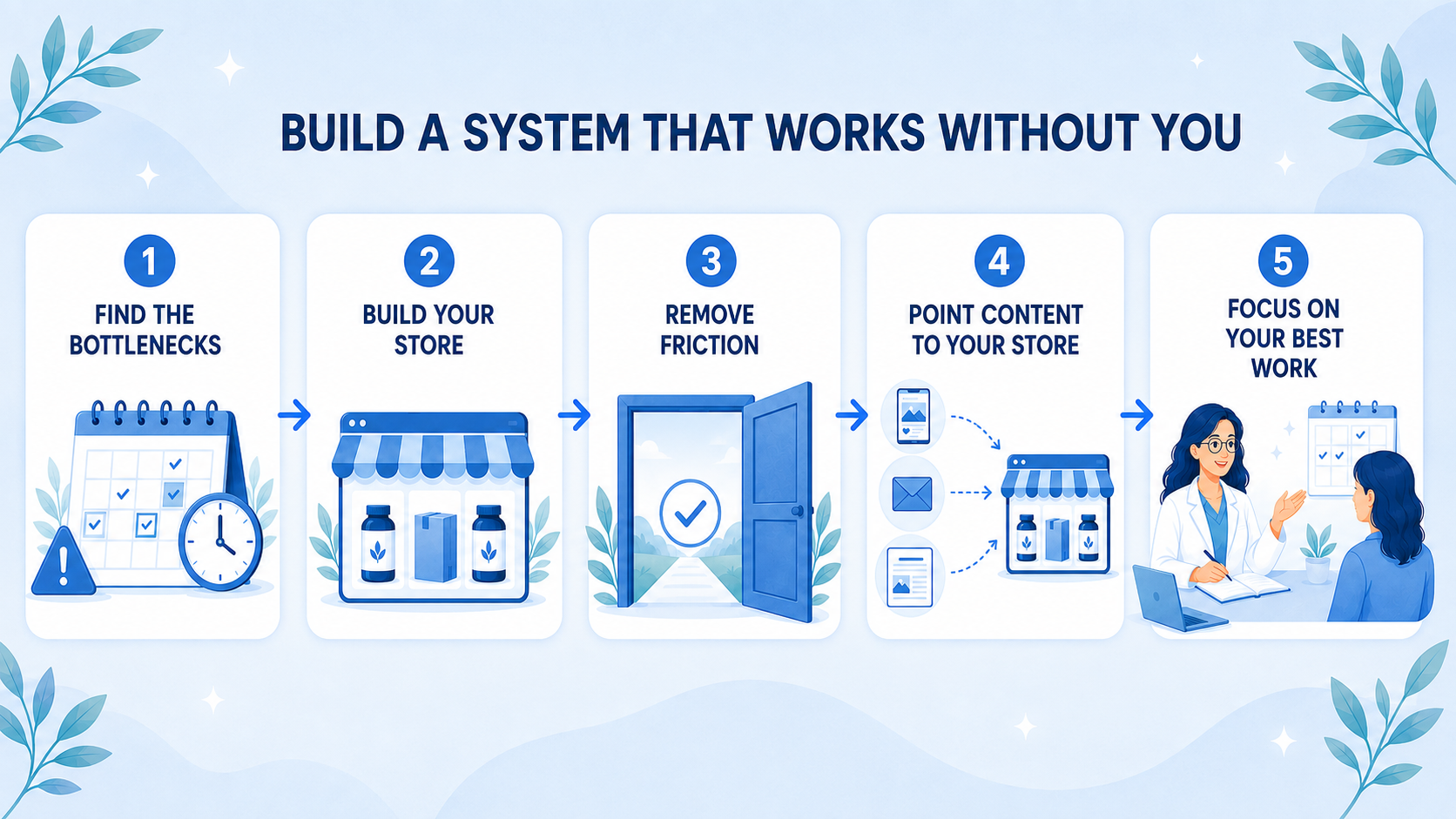
Five steps for building a practitioner Store that works without you.
The point
A personal brand is not the finish line. It is the fuel. On its own, it can quietly recreate the same trade you were trying to escape, one hour of your life for one unit of income. The practitioners who build real freedom are the ones who pair the brand with a system that keeps earning when they log off.
Build the audience. Then build the thing that serves them without you.
See what a storefront that works while you sleep looks like. Explore Store.
FAQ
-
Health practitioners can create a direct path from their educational content to the products they recommend. An open, branded Store allows audience members to explore those recommendations and make purchases without scheduling an appointment or contacting the practitioner first.
-
Practitioners can organize their frequently recommended supplements in one accessible Store and direct their audience there from podcasts, social content, newsletters, and presentations. This gives people a consistent place to find the products mentioned in their content.
-
A client list includes the people who formally work with a practitioner. An audience may also include podcast listeners, social followers, newsletter subscribers, event attendees, and others who trust the practitioner’s educational content but may never become clients.
-
Some report deeper sleep and better stress tolerance within days to weeks. Others experience a more gradual improvement in energy and focus. Adaptogenic effects are cumulative, so consistency over several weeks matters.
-
An open storefront allows people to explore and purchase recommendations without first creating an account or becoming a client. This reduces friction between discovering a product through the practitioner’s content and acting on that recommendation.
