
You ran the breath test, identified the subtype, and walked your client through a thoughtful herbal protocol. They left motivated. Three weeks later, they are guessing at doses, swapping your recommended formula for whatever oregano oil showed up first in a search, or quietly stopping halfway through the antimicrobial phase.
SIBO protocols are rarely short, and they are almost never one product. That makes them one of the clearest places where your clinical guidance and your clients' buying experience need to work together.
What is SIBO, and why does the subtype shape your recommendations?
Small intestinal bacterial overgrowth (SIBO) is an excess of dysbiotic bacteria in the small intestine, and the subtype your client tests positive for should guide nearly every product decision you make. Clients typically come in with gas, bloating after meals, abdominal discomfort, fatigue, constipation, or diarrhea, many of the same complaints associated with IBS.
Current guidance recognizes three distinct patterns:
Hydrogen-dominant SIBO, typically associated with diarrhea and bloating
Intestinal Methanogen Overgrowth (IMO), formerly called methane-dominant SIBO, commonly linked to constipation and bloating
Intestinal Sulfide Overproduction (ISO), formerly hydrogen sulfide SIBO, an emerging subtype that may show up as alternating stools, bloating, or sulfur-smelling gas
Each pattern calls for a different emphasis, which is exactly why a generic "gut cleanse" picked up by a client on their own so often falls short.
Why are more clients asking about natural SIBO support?
Clients increasingly want approaches that feel gentler on the body, and many arrive having already read about herbal options. Natural protocols focus on rebalancing the microbial environment with plant-based antimicrobials, gut-soothing nutrients, and short-term diet changes rather than relying on a single aggressive intervention.
For practitioners, this interest is an opening. Clients who are curious about herbal support are often highly engaged, and they are looking for someone to tell them which products, in what order, and for how long.
What natural strategies belong in a SIBO protocol?
Most natural SIBO protocols combine four categories of support, sequenced around the client's subtype and tolerance.
Herbal antimicrobials such as oregano oil, neem leaf, berberine, pomegranate peel, and allicin, which are widely used to support a healthier microbial balance
Gut lining support from nutrients like L-glutamine,which may help soothe the gut lining and support intestinal barrier integrity
Short-term dietary strategies such as low-FODMAP, low-fermentation, the SIBO Specific Food Guide, or the Bi-Phasic Diet, used temporarily to reduce fermentable carbohydrates and ease symptoms, not as long-term eating plans
Nervous system support through diaphragmatic breathing, gut-directed hypnotherapy, vagus nerve practices, and other mindfulness work that may support motility and the gut-brain connection
The goal is to address the underlying contributors to overgrowth while keeping disruption to the broader microbiome as low as possible.
Where do supplements fit in SIBO recovery?
Supplements do their best work when they are matched to the subtype and the phase of the protocol. There is no single SIBO formula that fits every client, but a few categories show up in most practitioner-built plans.
Antimicrobial botanicals like allicin and neem leaf, chosen to align with the client's hydrogen, methane, or hydrogen sulfide pattern
Digestive enzymes that may support digestion and nutrient absorption, which can mean less fermentation and gas
Motility support such as ginger and bitters, which may support the migrating motor complex (MMC), an important factor in long-term results and root-cause support for many.
Gut-supportive nutrients like L-glutamine, which can help support the gut lining during active phases
Because protocols move in phases, clients often need different products at different points. That is where clarity and access matter as much as the formulas themselves.
How should you choose SIBO supplements for your clients?
The right SIBO supplement is one you trust on quality and one your client can reliably get again when it runs out. When evaluating formulas, look for:
Clinically relevant ingredients that are third-party tested
No unnecessary fillers or added sugars that can irritate sensitive guts
A thoughtful balance of antimicrobial and gut-supportive compounds
Clear labeling and ingredient transparency
Then think about where your client buys it. When clients leave your office and shop on their own, they often land on a different product, a different dose, or a marketplace listing you cannot vouch for. Recommending directly through your own GetHealthy Store or through Script keeps the exact formula you chose in their hands and keeps you connected to their progress.
What is GI Ally, and where does it fit in a protocol?
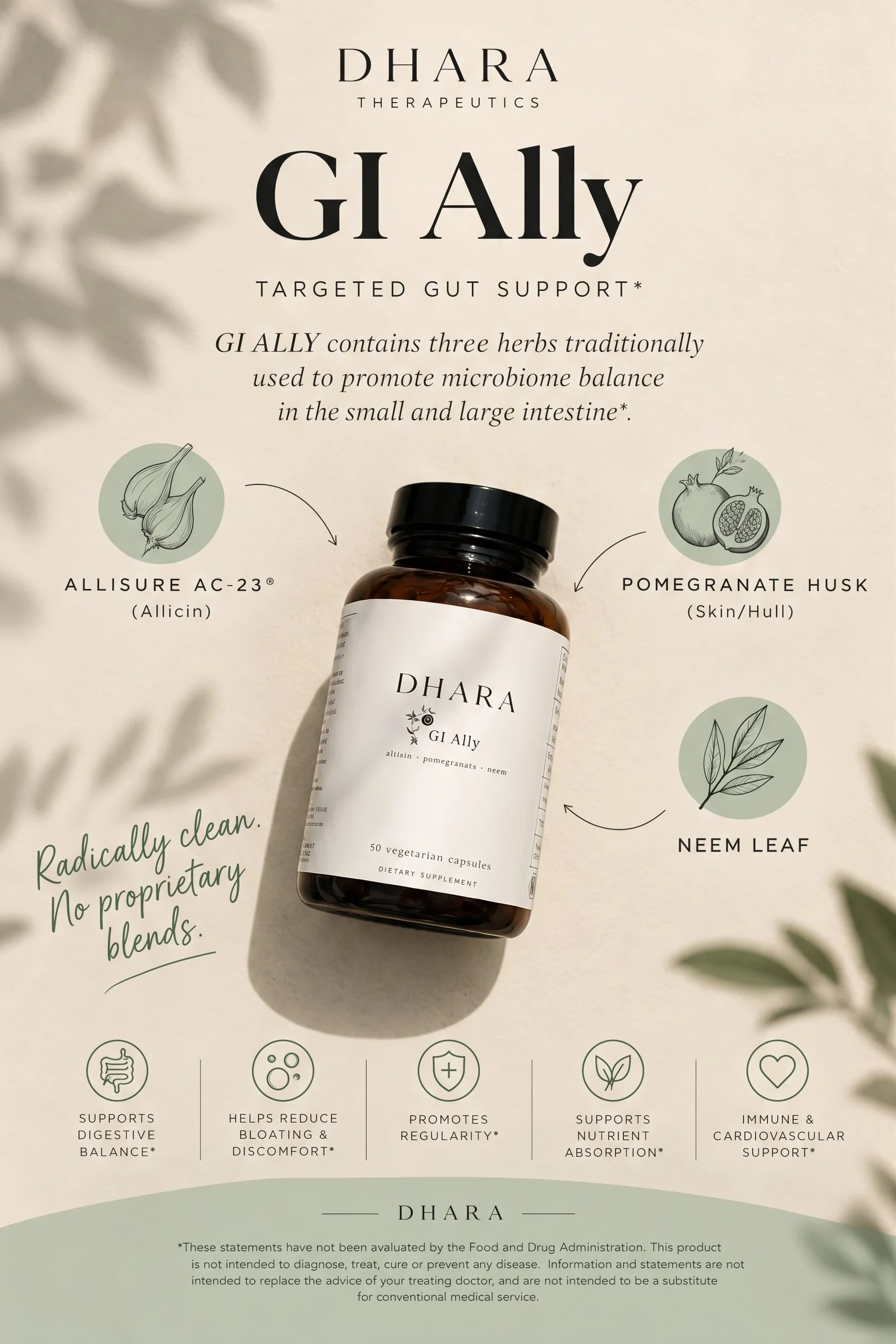
GI Ally by DHARA is a botanical formula built with today's understanding of SIBO and IMO in mind. It combines allicin, neem leaf, and pomegranate peel, three of the most researched and practitioner-trusted botanicals in natural SIBO and IMO protocols.
Each ingredient was selected to support microbial balance while staying gentle on the gut lining and on beneficial gut bacteria. GI Ally is free from unnecessary additives, which makes it a practical option for sensitive clients.
Practitioners use GI Ally in several ways:
As the core of an herbal antimicrobial phase
As an adjunct alongside prebiotics, motility support, or staged protocol
In the post-protocol phase for ongoing maintenance support
GI Ally is designed to complement a broader plan focused on balance and long-term resilience rather than serve as a one-size-fits-all answer.

How do you keep clients consistent through a SIBO protocol?
Consistency is what separates a protocol that works from one that stalls, and most of it happens after the visit ends. Clients need to know what to take in each phase, when to switch, and where to reorder without second-guessing.
A GetHealthy Store lets you build that structure around your recommendations. You can create a campaign-curated storefront for your SIBO protocol that groups the antimicrobial phase, gut lining support, and motility support in one place, so clients follow the sequence you designed. Guest checkout means clients can order without creating an account, which removes one more reason to put it off.
For individual clients who need a specific recommendation, Script lets you send exactly what they need, at the dose you intend, as part of your post-visit follow-through.
When clients can get your recommended products easily and in the right order, adherence improves, and so does the trust they place in your guidance.
Bring your SIBO protocols into your practice's ecommerce
Managing SIBO takes patience, personalization, and steady follow-through. Your clients are counting on you for the plan. Make it just as easy for them to follow it.
Explore GetHealthy Stores and Script to start recommending ProHealth Longevity online.
FAQ
-
The three recognized patterns are hydrogen-dominant SIBO, Intestinal Methanogen Overgrowth (IMO), and Intestinal Sulfide Overproduction (ISO). Each is associated with a different symptom pattern and typically calls for a different protocol emphasis.
-
Practitioners frequently use allicin, neem leaf, oregano oil, berberine, and pomegranate peel to support microbial balance, often paired with gut lining nutrients such as L-glutamine.
-
The migrating motor complex helps keep the small intestine clear between meals. Supporting motility with ingredients like ginger and bitters is a common part of the maintenance phase.
-
Grouping each phase's products in one place, offering simple reordering, and following up after the visit all help. A GetHealthy Store with a curated protocol storefront and guest checkout, or individual recommendations through Script, keeps clients on the plan you designed.
