
Someone finds your practice through a blog post or a video you shared. They like your approach, but they aren't ready to book a consultation yet, so they leave your website and the conversation ends there.
For many practitioners, that gap is where audience growth stalls. Your content earns attention, yet interested people have no clear way to stay connected until they're ready.
In Session One of GetHealthy's Grow Beyond 1:1 Consultations Bootcamp, Uli Iserloh of Big Boost Marketing showed how practitioners can close that gap with a connected lead capture system built from an opt-in page, a segmentation survey, a CRM, and relevant follow-up. The idea is straightforward: give people a useful reason to join your list, and know exactly what happens after they do.
Why should your practice build an email list?
An email list gives people a step between discovering your practice and being ready to work with you. Social media, your website, directory listings, and local talks can all introduce you, but discovery and readiness are different stages, and most people need time in between.
Email gives them that time. Subscribers can learn from you, get familiar with your approach, and explore their options before they decide. You also gain more control over the conversation, since you're no longer relying on someone catching your next social post. Instead, you can send a sequence that builds on whatever first caught their attention.
Picture someone who downloads your guide on sleep. They receive a welcome email with the resource, followed by a few messages that expand on the guide and introduce how your practice approaches sleep. Every email has context because you know where the relationship started.
What does a connected opt-in flow look like?
A connected opt-in flow moves someone from first discovery to relevant follow-up in five steps:
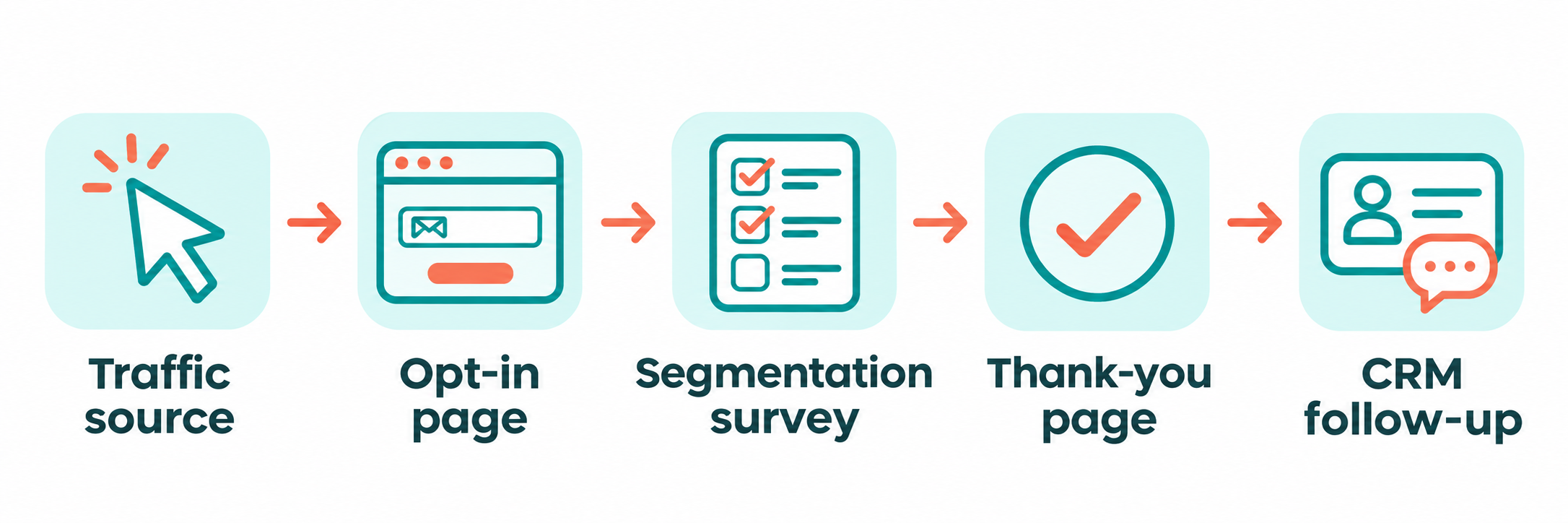
Each step has a job. Your traffic source brings people to the page, and your opt-in gives them a reason to share their contact information. The survey adds context, the thank-you page explains what comes next, and your CRM organizes the follow-up.
Before you build anything new, walk through that path in your own practice. Where do people discover you, where can they sign up, and what happens once they do? You may find you already have most of the pieces and simply need to connect them more intentionally.
What makes a good lead magnet for a wellness practice?
A good lead magnet answers a specific question your audience already asks. It's the resource someone receives in exchange for signing up. In the training, Uli shares formats like PDF guides, quizzes, mini-courses, and webinars.
The format matters less than the reason someone would want it. "Join our newsletter" asks visitors to commit without telling them much about what they'll get, while a focused resource makes the value obvious. A guide that helps someone prepare questions for a wellness consultation, for example, gives them a concrete reason to sign up.
Choose a format you can realistically create and maintain, and keep the topic tied to your expertise and the conversations you want to have with future clients. That connection makes your follow-up emails much easier to write.
What should your opt-in page include?
Your opt-in page should help someone decide whether they want one specific resource. Your main website invites visitors to explore your practice, while an opt-in page has a narrower job, so keep it focused on four things:
- What they’ll receive
- Who the resource is for
- Why it’s useful
- How to get it
Keep the first form short. Uli emphasized collecting enough information to follow up without adding friction, and a first name and email address are often enough to start.
Be clear about which messages people are signing up for. If SMS is part of your plan, ask for that permission as a separate choice instead of treating a phone number as consent to text.
How can a short survey make your follow-up more relevant?
A segmentation survey tells you what someone wants to hear about, which an email address alone can't. Placed right after the opt-in, it can capture educational interests, preferred formats, or the next step someone has in mind.
You might ask whether they'd rather read a guide, watch a short training, or learn more about your services, then use the answer to choose what you send next.
Keep the survey focused on marketing preferences and broad interests, and save health history and detailed questions for your clinical intake. You also don't need a long survey to see results. One question whose answer changes your next email is a strong start.
What should your thank-you page do?
Your thank-you page should confirm the resource is on its way and point to a relevant next step. Uli calls it a bridge page because it connects what someone requested with where the relationship can go next.
Use it to explain how they'll receive the resource, introduce your practice, and outline what they can do now. A short welcome video helps new subscribers put a face and voice to your name.
Some visitors will be ready to explore a consultation or a related collection in your GetHealthy Store, where they can check out as guests without creating an account. Others will want more education first. Make the next step easy to find while giving people room to keep learning.
How does a CRM keep your follow-up organized?
A CRM, or customer relationship management system, keeps track of who signed up, where they came from, and what should happen next. That context helps you avoid sending everyone the same message.
Useful details include the resource requested, the traffic source, survey responses, and whether someone has already booked a call. A person who has booked a consultation should get information on how to prepare, while someone still exploring may benefit more from an introductory email sequence.
Uli demonstrated the framework in GoHighLevel, but the core question applies to whatever system you use now: can you capture contacts, organize them, and send relevant follow-up without rebuilding the process by hand each time?
Where should you start if your current system isn't working?
Start by fixing one weak link rather than rebuilding everything. Test your current flow as if you were discovering your practice for the first time: submit the form, open the email, and follow every link.
Then pick one improvement:
- Make your opt-in easier to find
- Clarify the value of your resource
- Shorten the first form
- Add one useful question after signup
- Strengthen the thank-you page
- Write a welcome email that delivers the resource and explains what comes next
Building an audience you own starts with a clear invitation and grows through useful, consistent communication. When those steps connect, interested people can build a relationship with your practice long before they're ready to buy or book.
Go deeper with the full Bootcamp
This post covers the core ideas from Session One. The full session walks through the complete lead capture framework step by step, including opt-in pages, segmentation, CRM organization, and follow-up.
Session One: Acquisition, Build the Audience You Own is part of the Grow Beyond 1:1 Consultations Bootcamp, a paid, three-session on-demand program for practitioners ready to grow their reach. Session One focuses on acquisition, and the remaining two sessions cover activation and retention, so you can build your list, engage it, and keep those relationships growing.
When you enroll, you get access to all three sessions to watch at your own pace.
GetHealthy clients receive a discount on the Bootcamp. Email marketing@gethealthy.store for details.
FAQ
-
A lead magnet is a free resource, such as a PDF guide, quiz, mini-course, or webinar, that someone receives in exchange for joining your email list. The strongest ones answer a specific question your audience already asks.
-
Start with a first name and email address. Asking for more up front adds friction, and you can learn more later through a short segmentation survey.
-
Only if they've clearly agreed to receive text messages. Ask for SMS consent as a separate, explicit choice instead of assuming a phone number grants permission.
-
A segmentation survey asks about marketing preferences and broad interests so you can send more relevant emails. A clinical intake collects health information for care and belongs in a separate, secure process.
-
No. The framework works with any system that lets you capture contacts, organize them by source and interest, and send automated follow-up.
